

Whether you’re a thriller writer struggling to convey the authenticity your audience craves or a crime journalist desperate to get the facts right, The Gun Encyclopedia for Writers is your one-stop resource for all things firearms and ammunition. With over 100 entries covering firearm mechanics, ammunition basics, correct terminology and how to use all this information in your work, this detailed gun encyclopedia will make your writing bulletproof.
Don’t know where to start? Download a free copy of 5 Facts Writers Should Know About Guns for a brief guide to the basics of firearms.
A • B • C • D • E • F • G • H • I • J • K • L • M • N • O • P • Q • R • S • T • U • V • W • X • Y • Z
Action
The working mechanism of a firearm. The action consists of the parts of a firearm that allow it to be loaded, unloaded and fired. The action also contains the pressure created in the chamber during the firing process. For types of actions, see:
- Automatic Action (Machine Gun)
- Blowback Action
- Bolt Action
- Break-Open (or Hinged Frame, Tip-Up, Top Break, Under-Lever) Action
- Double Action
- Hybrid Action
- Lever Action
- Pump (or Slide) Action
- Revolver Action
- Semiautomatic Action
- Single Action
- Single Shot Action
Air Gun
A gun that uses compressed air or gas (usually carbon dioxide) to propel a projectile. In the United States, most air gun projectiles are 17 to 22 caliber round or cup-shaped pellets. True air guns differ from guns that use spring force to propel projectiles (commonly known as BB guns). Air guns are also known as air rifles, pellet rifles or pellet guns.
Ammunition
The material which is loaded into a firearm and fired—typically a cartridge or a shotshell.
Assault Rifle
A compact, select-fire, detachable box magazine-fed rifle, that utilizes a centerfire rifle cartridge and is designed primarily for military use. The AK-47 is a popular example of an assault rifle.

Assault Weapon
A slang term to describe any firearm with a military appearance or a large magazine capacity. Despite some assault weapon legislation in the United States, there is no clear, consistent definition of an assault weapon. The AR-15 is usually considered an assault weapon, but it is not an assault rifle, because it is a semiautomatic, not a select-fire, rifle.

Automatic Action
A firearm design that continually feeds and cartridges, and extracts and ejects fired cartridge cases as long as the trigger is fully depressed, there are cartridges in the feed system, and the firearm does not malfunction. Also called fully automatic, full auto or a machine gun.
Backstrap
The part of the frame that forms the back of the grip of pistols and revolvers.

Ballistics
The study of projectiles in motion. A term often used by laypeople to refer to forensic firearms identification. Ballistics is usually divided into three parts:
- Interior ballistics: The study of the projectile’s movement inside the firearm. The study most closely related to forensic firearms identification.
- Exterior ballistics: The study of the projectile’s movement between the muzzle and the target. Also known as trajectory analysis. When such analysis is performed, it is done by police crime scene investigators rather than forensic scientists.
- Terminal ballistics: The study of the effect of a projectile’s impact on the target. Also known as wound ballistics. When the projectile strikes and kills a living creature, this analysis is performed by forensic pathologists.
Barrel
A part of a firearm consisting of a cylindrical tube through which a bullet, projectile or shot charge travels on its path toward the target. A barrel may be rifled or smooth (unrifled).

BB Gun

(1) A gun that uses spring force to propel projectiles.
(2) A non-firearm gun that shoots BBs, or pellets of 0.175 inches in diameter.
Bearing Surface
That portion of a bullet that comes into direct contact with the interior of the barrel when the bullet is fired. Also known as the band.
Blowback Action
A design found in semiautomatic and automatic firearms in which the weight of the bolt, the inertia of some component, and/or a mechanical delay is the main locking force and no mechanical locking of the breech occurs. The bolt pushes the cartridge into the chamber, and its weight holds the chamber closed to contain and direct the pressure created during the firing process. Hi-Point handguns operate by blowback action.
Blunderbuss
A short-barreled firearm with a bell-shaped muzzle used for close-range fighting in the eighteenth century. Like shotguns, the blunderbuss fired multiple projectiles that spread out as they left the barrel.

Bolt
The locking and cartridge head support mechanism of a firearm that operates in line with the axis of the bore. The bolt pushes the cartridge into the chamber and holds it in place. Also known as the breech bolt.
Bolt Action
A firearm in which the shooter manually moves the bolt forward and backward, always in line with the bore, to load, unload and cock the weapon. When in battery, the bolt is locked to the receiver and must be manually unlocked by the shooter.

Bore
The interior of a barrel forward of the chamber.
Break-Open (or Hinged Frame, Tip-Up, Top Break, Under-Lever) Action
A firearm design in which the shooter loads the weapon by pivoting the barrel up, down or sideways, usually by movement of a lever on the top, bottom or side of the frame. Once loaded, the shooter pivots the barrel back into the frame so that it aligns with the firing pin.
Breech
The rearward end of a firearm barrel into which ammunition components are inserted. The breech is closely related to the chamber. The breech is the opening at the rear of the barrel, and the muzzle is the opening at the front of the barrel. The chamber is the section of the barrel that holds a cartridge before it is fired.
Breech Face
That part of the bolt or slide which locks against the rear of the chamber and supports the head of the cartridge case or shotshell during firing.

Breech Face Marks
Impressed marks made by the breech face on the head and/or primer of the cartridge case due to pressures produced during the firing process. Breech face marks are one area used by forensic firearms examiners to compare fired cartridge cases.
Bullet
A non-spherical projectile for use in a rifled barrel. Some common types of bullets include:
- Armor-Piercing Bullet: (1) A projectile consisting of a hardened core or wholly composed of a substance other than lead or lead alloy; (2) Any projectile designed or represented to penetrate metal or body armor.
- Frangible Bullet: A projectile designed to disintegrate upon impact with a hard surface in order to minimize ricochet. Sometimes referred to as a disintegrating bullet or gallery bullet.
- Full Metal Jacket Bullet: A projectile (usually lead) enclosed in a thin layer of another metal (e.g. copper or brass) or polymer. In a full metal jacket bullet, this outer layer or “jacket” covers the entire bullet except for the base. Also known as full jacketed, full patch, full metal case, metal cased, metal patched and ball ammunition.
- Hollow Point Bullet: A projectile with a cavity in the nose that causes the bullet to expand when it strikes its target.
- Jacketed Bullet: A projectile having an inner (usually lead) core enveloped by a thin layer of another metal or polymer.
- Jacketed Hollow Point Bullet: A bullet entirely enclosed by its jacket, except for a cavity at the nose to facilitate expansion.
- Lead Bullet: A projectile formed from a lead alloy.
- Mushroomed Bullet: A fired projectile whose nose has expanded upon impact to form a mushroom-like shape.
- Semi-jacketed Bullet: A projectile with a partial jacket and exposed lead nose.
- Semi-jacketed Hollow Point Bullet: A projectile with a partial jacket and exposed lead nose with a cavity.
- Soft Point Bullet: A jacketed projectile with a portion of its core exposed at the nose.
- Total Metal Jacket Bullet: A projectile in which the bullet jacket encloses the entire bullet, including the base.
- Tracer Bullet: A projectile that has a burning compound in its base which permits observation of its flight.
Butt
(1) In handguns, the bottom part of the grip.
(2) In long guns, the rear or shoulder end of the stock.

Caliber
(1) For a firearm, cartridge or cartridge case, caliber refers to the name of the cartridge designed to be fired in a particular firearm. This name references a set of dimensions of the cartridge or the firearm.
(2) For a firearm barrel, caliber refers to the interior diameter of the barrel measured between opposing lands.
(3) For a fired bullet, caliber refers to the diameter of the bullet measured between opposing groove impressions.
For Writers

The important thing to remember about caliber is that, in order to function correctly, the caliber of a cartridge must match the caliber of the firearm. And the caliber of a bullet must match the caliber of the barrel through which that bullet will be fired. A 9 mm Luger caliber cartridge is too small for a 45 Auto caliber firearm. And a 40 caliber bullet is too large for a 22 caliber barrel.

Battery sizes offer a good analogy for caliber. AAA batteries have a standard set of dimensions. Any AAA battery will fit in any device designed to hold AAA batteries. But AA and AAAA batteries won’t fit properly in AAA devices, just as a cartridge won’t fit properly in the firearm of the wrong caliber.

In a few cases, a firearm can fire multiple calibers. For example, a 5.56 x 45 mm caliber rifle can fire 5.56 x 45 mm caliber and 223 Remington caliber cartridges. The two cartridges have essentially the same dimensions, but 5.56 x 45 mm caliber cartridges generate higher pressures than 223 Remington caliber cartridges. But unless you know what you're doing, I suggest matching the caliber to the firearm.
Carbine
A short, lightweight rifle originally designed for mounted troops.
Cartridge
A single unit of ammunition consisting of a cartridge case, which contains a primer, propellant and a bullet. Some common types of cartridges include:

- Ball Cartridge: A military term for a cartridge with a full metal jacket bullet or solid metal projectile. Also known as ball ammunition.
- Blank Cartridge: A cartridge that is designed to produce a loud noise and is loaded without a bullet.
- Bottleneck Cartridge: A cartridge with a cartridge case that has a wider body and angular shoulder that narrows down to a smaller diameter neck (similar to the shape of a wine bottle).
- Centerfire Cartridge: Any cartridge with its primer in the center of the cartridge case head. Most contemporary cartridges are centerfire cartridges.
- Dummy Cartridge: An inert cartridge which cannot be fired. Dummy cartridges are used to test the functionality of a firearm and/or its magazine without the risk of accidentally firing the weapon.
- Wildcat Cartridge: Any cartridge not standardized within the shooting industry or not standardized in the United States by the Sporting Arms and Ammunition Manufacturers Institute (SAAMI). These cartridges typically arise from an individual altering existing cartridge cases to suit their own needs and are not mass-produced.
- Rimfire Cartridge: A cartridge with a rim around the head that protrudes beyond the wall of the cartridge case and contains the primer. Rimfire cartridges are the alternative to centerfire cartridges and are used primarily for small calibers (e.g. 22 Short, 22 Long and 22 Long Rifle).

For Writers

Remember that a bullet is a part of a cartridge. A shooter loads cartridges into a firearm. When a firearm is fired, the bullet leaves the cartridge and travels toward the target. If you are going to get down to cartridge-level detail (e.g. bullets traveling backward in time from a target to a firearm as in the film Tenet), make sure you account for all the components of the cartridge.
Cartridge Case
The part of a cartridge which contains the other components (the primer in the cartridge case head, and the propellant and bullet inside the cartridge case). During the firing process, the cartridge case contains the expanding gases produced by the burning propellant.
For Writers

Non-firearms examiners—especially police officers and attorneys—often refer to cartridge cases as "shell casings." So when choosing what terminology to use in your writing, consider the character and subject matter. A police officer or attorney might very well say “shell casing” or “casing.” A forensic firearms examiner would not. If you write non-fiction, I recommend sticking with “cartridge case.”
Chamber
The rear part of the barrel that has been shaped to accept a specific cartridge or shotshell. In a revolver, each of the holes in the cylinder is considered a chamber.
Chambering
(1) The act of inserting a cartridge into the chamber.
(2) The step in the manufacturing process of a barrel or cylinder in which the chamber is reamed.
Choke
A narrowing at or near the muzzle end of a shotgun barrel for the purpose of restricting the spread of the shot pellets.
Class Characteristics
Features of an item that associate an item with a particular group of items, but do not distinguish that item from the other items within its group. Class characteristics result from design factors and are determined prior to manufacture. The model and color of a car are examples of class characteristics. In forensic firearms identification, the caliber of a firearm or cartridge is an example of a class characteristic.
Clip
(1) A metal device that hold five to ten cartridges and is used to rapidly load the magazine of a pistol or rifle. Also known as a stripper clip or charger.
(2) An en bloc clip holds cartridges either in a single column or in two staggered columns. The clip is inserted directly into the magazine well of certain firearms (e.g., U.S. M1 Garand rifles and Italian Carcano rifles and carbines) and is necessary for the firearm to function.
(3) A misnomer for a detachable magazine.
Cock
To place a firing mechanism (hammer, firing pin, or striker) in a position for firing, typically by retracting the hammer, slide or bolt.
Comparison Microscope
An instrument that consists of two compound microscopes connected by an optical bridge, which allows for two objects to be viewed simultaneously, side-by-side, at the same magnification and in the same field of view. The comparison microscope is the primary tool used by forensic firearms examiners to compare fired bullets and fired cartrdige cases.

Consecutive Matching Striae (CMS)
The basis for a quantitative comparison of fired bullets. When a bullet travels down the barrel of the firearm, microscopic imperfections in the barrel may produced striated, or scratched, marks on the surface of the bullet. If a striation on one bullet is consistent with a striation on a second bullet during microscopic comparison in terms of position, width and shape, the two striations are said to match. If adjacent striations match with no explained differences between them, they are said to be consecutive matching striae.
Cylinder
The rotating component of a firearm (typically a revolver) that contains the chambers.

Derringer
A generic term applied to many variations of small one-, two- or even four-shot pistols. The original designer, Henry Deringer, spelled his name
“Deringer,” not “Derringer.”
Distance Determination
A forensic analysis that attempts to determine the distance between a firearm muzzle and the target in a shooting incident. To perform a distance analysis, a scientist will fire the suspect firearm using the same ammunition from the shooting incident at targets at a series of different distances. The scientist will then compare patterns of gunpowder or gunshot residue deposited upon each target to the corresponding pattern on the target from the incident. Based on this analysis, the scientist can provide a limited range of distances at which the shooting occurred.
Double Action
A firearm mechanism in which a single pull of the trigger both cocks and then releases the hammer or striker.
Double-Barrel
A firearm with two barrels mounted on a single frame. The barrels may be aligned vertically (over-under) or horizontally (side-by-side).
Ejector
The part of a firearm that pushes a cartridge, cartridge case or shotshell out of the firearm. In most cases, the ejector is used to expel a fired cartridge case or shotshell so that an unfired round of ammunition can be loaded.
Extractor
The part of a firearm that removes a cartridge, cartridge case or shotshell from the chamber of the firearm. The extractor pulls the ammunition component out of the chamber, and the ejector pushes it out of the firearm. In a semiautomatic firearm, this happens as part of the firing process. In other firearms, extraction and ejection must be done manually.
Firearm
A tool that uses the force of expanding gases to propel a projectile through a barrel and toward a target downrange. This term is often used synonymously with “gun.” Strictly speaking, there are many types of guns other than firearms (air guns, water guns, etc.). A firearm differs from other guns because it uses burning propellant to produce the expanding gases that propel the projectile.
Firearms Identification
A discipline of forensic science which attempts to determine if two or more bullets, cartridge cases or other ammunition components were fired by the same firearm.

Firing Pin
The part of a firearm that strikes the primer of a cartridge or shotshell to initiate the firing process.
Firing Pin Impression
The indentation made on the primer of a cartridge case or shotshell when it is struck by the firing pin. Firing pin impressions are one area used by forensic firearms examiners to compare fired cartridge cases.
Firing Process
To fire a firearm, the shooter pulls the trigger, which causes the firing pin to strike the primer on the rear end of the cartridge case. Striking the primer creates a spark, which ignites the propellant inside the cartridge case. The burning propellant produces rapidly expanding gases that force the bullet out of the cartridge case and down and out of the firearm barrel. Those same expanding gases push the cartridge case rearward until it makes forcible contact with the breech face.
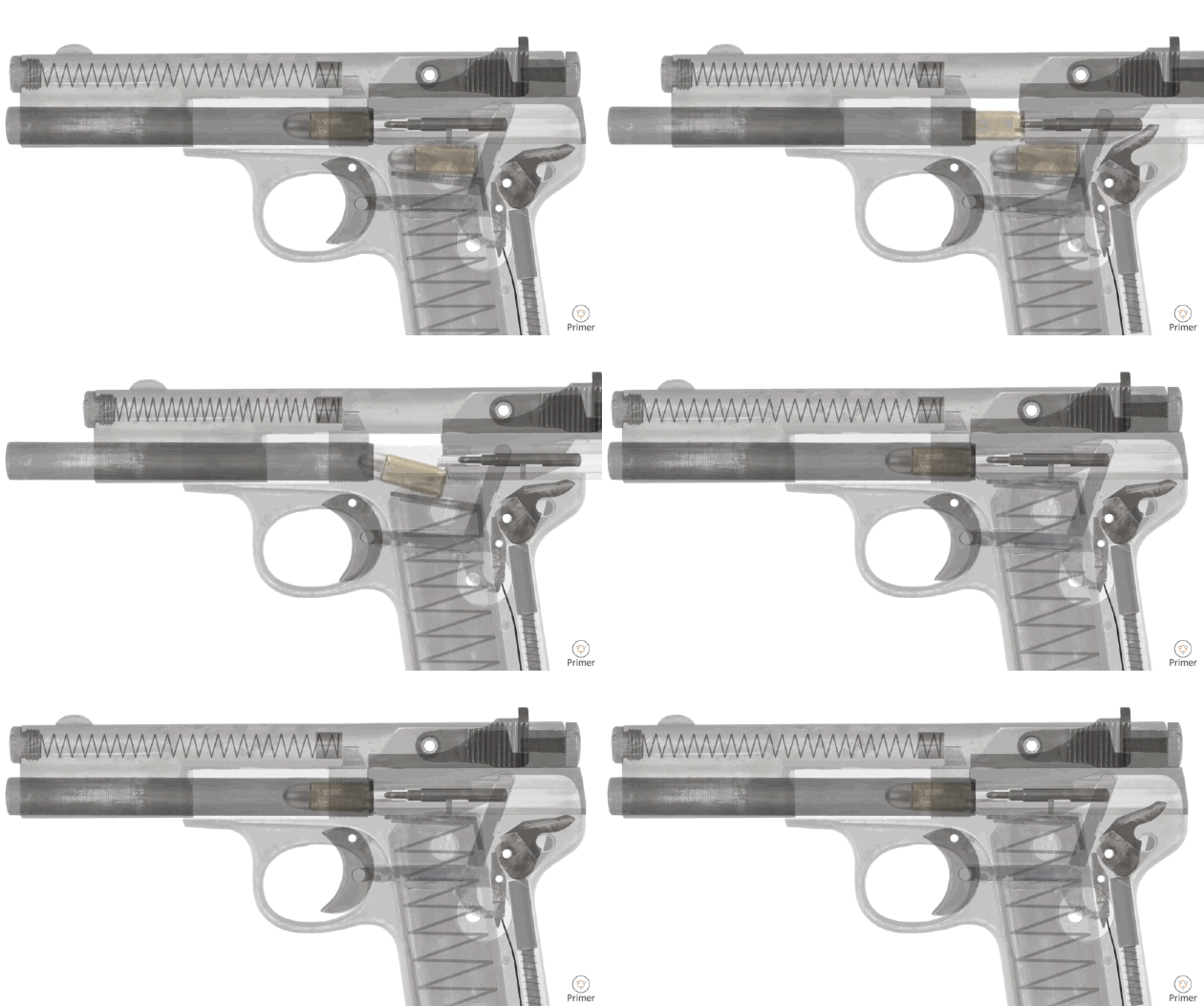
The firing process of a semiautomatic pistol
For Writers

Knowing the basics of how firearms function will allow you to avoid some of the mistakes that commonly show up on the page and screen. For example, you’ve probably seen an interrogation scene where the interrogator points a semiautomatic pistol at his captive and says something to the effect of, “Tell me what I want to know, or I’ll shoot you.” And when the prisoner still refuses to talk, the interrogator racks (pulls back and releases) the slide, as if to say, “Now I’m really serious.”

Unless an unfired cartridge comes flying out of the firearm when the interrogator racks the slide, there was no cartridge in the chamber to begin with and the interrogator couldn’t actually have shot his captive when he first threatened to do so. The same logic applies to most other firearm actions. If there was no cartridge in the chamber to begin with, the interrogator was bluffing when he first threatened to shoot his prisoner and was inexplicably wielding a gun he wasn't prepared to fire. If there was a cartridge in the chamber, working the action to make that threatening "click" sound would eject the cartridge.

Single-action revolvers are a notable exception. If the revolver's hammer is lowered, the shooter has to cock it in order to fire a shot. Cocking the hammer won't eject a cartridge, but again, it indicates the interrogator was unable to fire when he first threatened to do so.
Flintlock
A historical firing mechanism invented by Marin Le Bourgeoys in 1610. Pulling the trigger released an external hammer which held a piece of flint. The flint struck a steel plate, called a frizzen, creating sparks that ignited powder in a pan on the side of the barrel, which in turn ignited the gunpowder inside the barrel. Simpler and more effective than the matchlock or wheel lock, the flintlock mechanism remained in use on firearms for over two centuries.

For Writers

The idiom "a flash in the pan" likely dates to sixteenth century flintlock misfires (though a similar malfunction could occur with matchlocks and wheel locks). In some instances, the powder in the pan would ignite, but the burning gas would not enter the barrel and ignite the gunpowder inside, thus producing a spectacular effect with no significant payoff.
Forearm (or Forend)
The forward part of a two-piece stock.

Forensic Science
The study and application of science to legal and criminal matters.
Frame
In revolvers, pistols and break-open firearms, the basic unit of a firearm consisting of the firing and breech mechanisms and to which the barrel and grips are attached. In the firearm types listed above, the frame is the part of the firearm the shooter holds and where the serial number is stamped.

Front Strap
The part of the frame that forms the front of the grip of pistols and revolvers.

Gas Operated
An automatic or semiautomatic firearm in which the gases produced by the firing process are used to unlock the bolt or slide and complete the cycle of extracting and ejecting. This action is usually performed in conjunction with a spring that returns the bolt or slide to battery. Examples of gas operated firearms include the Remington Model 1100, US M1, US M14, US M16 and IMI Desert Eagle.
Gauge
A term used to identify the size of a shotgun barrel, and the equivalent of caliber for rifles and handguns. The gauge of a shotgun is equal to the number of round lead balls of the same diameter as the barrel that equal one pound. As an example, a 12 gauge shotgun has a barrel diameter equal to that of a round lead ball weighing 1/12 pound. Unlike caliber, where larger calibers indicate barrels of greater diameter, smaller gauge values indicate barrels of greater diameter (e.g. a 12 gauge shotgun has a larger barrel than a 16 gauge shotgun).
Grain
A unit of weight commonly used in American and English measurements of ammunition components. There are 7,000 grains in one pound and 437.5 grains in one ounce. Cartridges of the same caliber may contain bullets of different weights, though a few weights are standard for each caliber. For example, 9 mm Luger cartridges usually contain bullets weighing 115, 124 or 147 grains.
Grip
(1) In handguns, the part of the frame where the shooter holds the firearm.
(2) In long guns, the portion of the stock located behind the action which is normally grasped by the shooter’s trigger hand. Also known as the wrist.

Grip Safety
A safety on the grip of some handguns (e.g. Colt M1911 pistol) which prevents the firearm from firing until the safety is depressed, typically accomplished by grasping the grip correctly.

Groove
Part of the rifling of a barrel. The grooves are the cut or impressed areas of the rifling.
Groove Impression
The negative impression of a barrel groove on the surface of a fired bullet. In a barrel, the grooves are lowered compared to the lands. On a fired bullet, the groove impressions are raised compared to the land impressions.
Gunpowder
A variety of powders used in firearms and cartridges as propellant. A term commonly used for cartridge and muzzle-loading propellant.
Gunshot Residue
The total residues resulting from the discharge of a firearm. Gunshot residue includes both propellant and primer residues, carbon-based and metallic residues from projectiles, fouling, and any lubricant associated with the bullets. Gunshot residue patterns are used in distance determination analysis. Crime scene investigators may swab the hands and wrists of a shooting suspect so that a forensic laboratory can test for the presence of gunshot residue to indicate they were in the presence of a discharged firearm.
Hammer
A part of some firearms which rotates forward to strike the primer or firing pin (which in turn strikes the primer). Hammers may be internal or external.

Hammer Block
(1) A part of some firearms that prevents the hammer from resting on or contacting the firing pin except when the trigger is pulled.
(2) A safety device which restricts hammer movement.
Hammer Rebound
A safety feature of some firearms in which a spring pushes the hammer away from the firing pin after a shot has been fired. Firearms with a hammer rebound generally have a hammer block. The rebound moves the hammer away from the firing pin, and the block keeps the hammer from accidentally contact the firing pin.
Handgun

A firearm designed to be held and fired with one hand.
Head
The base of a cartridge case that contains the primer and is the location of the headstamp.
Headstamp
Numbers, letters, symbols or a combination thereof stamped into the head of a cartridge case or shotshell to identify the manufacturer, caliber, gauge or other information.
Hybrid Action
A firearm design that has characteristics of both single action and double action systems. For example, a pistol action which requires the slide to retract and partially cock the hammer or striker, and a trigger pull to further cock and release the hammer or striker.
In Battery
The condition of a firearm when the breech is closed and the firearm is ready for firing.
Individual Characteristics

The random imperfections or irregularities of an object. Individual characteristics may occur incidental to the manufacturing process, or they may arise after manufacturing as a result of use, corrosion or damage. Individual characteristics are specific to an object and distinguish it from other objects. In firearms identification, individual characteristics are the microscopic irregularities on the parts of a firearm which may be imparted to bullets and cartridge cases during the firing process.
Land
Part of the rifling of a barrel. The lands are the uncut or unimpressed areas of the rifling.
Land Impression
The negative impression of a barrel land on the surface of a fired bullet. In a barrel, the lands are raised compared to the grooves. On a fired bullet, the land impressions are lowered compared to the groove impressions.
Lever Action
A firearm design in which the shooter cycles the action to load, unload and cock the weapon by manipulating an external lever generally
located below the receiver.

Load
(1) The act of putting ammunition into a firearm magazine or chamber.
(2) The combination and quantity of components used to assemble a cartridge or shotshell.
Loaded Chamber Indicator
A part of some firearms that signifies a cartridge is chambered when the firearm is in battery. It is typically a small rod, raised extractor or other mechanism that protrudes or raises to indicate the firearm is loaded.
Lock
The action, either manual or automatic, of closing the breech and holding the bolt of a firearm in place immediately prior to firing. Locking secures the breech and chamber to safely contain the pressure caused by discharging a cartridge during the firing process.
Locked
The condition of a firearm action in which the bolt is secured with the chamber to resist being blown back by chamber pressure.
For Writers

You may have heard the term "locked and loaded." Now you know what it means. A loaded firearm has ammunition in its chamber. A locked firearm is securely closed and ready for firing. A locked and loaded firearm can be fired by pulling the trigger. What about other combinations of locking and loading?

Unlocked and loaded means that the firearm has ammunition in the chamber with the breech in the open position. When I worked as a forensic firearms examiner, I sometimes had to test-fire a semiautomatic pistol that was submitted without a magazine. I often did so by opening the slide (bolt mechanism) and manually inserting the cartridge into the chamber. At this point, the gun was unlocked and loaded. I couldn't fire it until I closed the slide, and it wouldn't be a good way to carry the gun because the cartridge could easily fall out of the chamber. To fire the gun, I closed the slide and pulled the trigger.

Locked and unloaded means that the bolt is in the forward/closed position, and there is no cartridge in the chamber. There could be a magazine containing cartridges inserted in the firearm in this scenario, but the firearm itself would not be loaded. Locked and unloaded is often a transition phase during the loading of a firearm. The shooter puts a cartridge-containing magazine into a locked and unloaded gun, then manipulates the action to chamber a cartridge and make the firearm locked and loaded.

Unlocked and unloaded means that the bolt is is in the retracted/open position, and there is no cartridge in the chamber. This is the safest condition for a firearm, because anyone handling the firearm can see there is no cartridge that can be fired. Any time I received a firearm as evidence, showed a firearm to another firearms examiner, or presented a firearm while testifying in court, I removed the magazine (if applicable) and made sure the firearm was unlocked and unloaded.
Long Gun
A firearm designed to be held with both hands and supported by the shooter’s shoulder against the stock.
Magazine
A container for cartridges which has a follower to support the cartridges and a spring to push the follower and the cartridges toward the opening of the magazine so that the cartridge nearest the opening can be loaded into the chamber of a firearm. The magazine may be detachable or an integral part of the firearm. Some common types of magazines include:
- Blind Box Magazine: An integral magazine with a permanently closed bottom. Loading and unloading are accomplished through the same opening.
- Box Magazine: A rectangular magazine attached to or inserted into a firearm that holds cartridges stacked on top of one another.
- Detachable Magazine: Any magazine that can be removed from the firearm for reloading.
- Drum Magazine: A circular magazine in which the cartridges are arranged in a spiral around the central axis of a wind-up mechanism. These are generally large-capacity magazines, most commonly used on submachine guns (e.g. Thompson submachine gun).
- Integral Magazine: A magazine permanently attached to a firearm.
- Rotary Magazine: A type of magazine in which the cartridges are arranged about a central rotating spindle or carrier. This type of magazine may be referred to as a Mannlicher magazine (e.g. Mannlicher rifles).
- Single Stack Magazine: A box magazine with a single column of cartridges.
- Staggered Stack Magazine: A box magazine with two zigzagged columns of cartridges. This increases the capacity without lengthening the magazine. Also known as a double-stack magazine.
- Tubular Magazine: A narrow cylindrical magazine in which the cartridges are arranged end-to-end. These are typically used in long guns and are located under the barrel or in the stock.

Magazine Well
That opening in a firearm into which the user inserts a detachable magazine.
Matchlock
The first mechanical ignition system, developed in the early fifteenth century. Pulling the trigger lowered an S-shaped arm, called a serpentine, that held a match. The match ignited priming powder in a pan attached to the side of the barrel, which in turn ignited the gunpowder in the barrel to fire the weapon.

Misfeed
A malfunction in a repeating firearm in which a cartridge or shotshell fails to enter the chamber completely. Also known as failure to feed.
Misfire
A failure of a cartridge or shotshell to fire after the firing pin strikes the primer. A misfire occurs when the primer does not produce a spark or the primer spark does not ignite the propellant.
Musket
A historical muzzle-loaded long gun with an unrifled barrel. Muskets had different firing mechanisms over the course of history, including, in chronological order, matchlocks, wheel locks, flintlocks and percussion caps. Whatever the firing mechanism, the shooter loaded gunpowder and a projectile into the muzzle end and pushed the load down the barrel with a ramrod. The shooter pulled the trigger to fire the weapon, then repeated the loading process in order to fire a second shot.

For Writers

The sixteenth-century muskets developed by the Spanish weighed at least eighteen pounds and fired projectiles of 70-85 caliber (roughly 0.70-0.85 inches in diameter). By contrast, modern rifle bullets are typically around 0.20-0.40 inches in diameter. Large-caliber projectiles produced a massive recoil when the musket was fired. The weight of the musket helped dampen the recoil, but carrying and firing a musket required substantial strength. For that reason, their use was limited to soldiers capable of managing such a weapon—a new military elite called musketeers. So if you plan to use a musket in your story, make sure your character is strong enough to handle that weapon.
Muzzle
The forward end of a firearm barrel from which the projectile emerges.
Muzzle Loader
A firearm loaded with gunpowder and projectile(s) through the muzzle end of the barrel or through the front end of a cylinder in the case of a muzzle loading revolver.

Nose
The tip of a bullet.
Ogive
The curved portion of a bullet between the bearing surface and the nose.
Out of Battery
The condition of a firearm when the breech is not in proper position for firing.
Pellet
(1) One of the multiple spherical projectiles loaded into shotshells. Also known as shot.
(2) A nonspherical projectile used in some air guns.
Percussion Cap
A small, generally cylindrical metallic cup containing a priming compound used to ignite the powder charge in muzzle-loading firearms. The percussion cap was located on the outside of the firearm. Pulling the trigger released a hammer, which would strike the percussion cap and ignite the primer. Percussion caps were the bridge between flintlocks and modern cartridges and made the ignition mechanism more weather-resistant.


Pistol
A handgun whose chamber is part of the barrel.
Primer
The ignition component of a cartridge. Striking the primer creates a spark that ignites the propellant to initiate the firing process.
Projectile
An object propelled by an external force that continues to move by its own inertia (e.g. a bullet propelled from a firearm by the force of rapidly expanding gases).
Propellant
The chemical substance inside a cartridge that burns when ignited by the primer and produces rapidly expanding gases to propel the projectile(s). Commonly known as gunpowder.
Pump (or Slide) Action
A firearm with a movable forearm that the shooter moves back and forth parallel to the barrel. Pulling the forearm backward extracts and ejects the cartridge, cartridge case or shotshell from the chamber. Pushing the forearm forward chambers a new cartridge or shotshell.

Quantitative Consecutive Matching Striae (QCMS) Identification Criteria
A numerical standard for the quantitative assessment of consecutive matching striae (CMS) when comparing fired bullets. Previous research has established the maximum number of CMS in bullets fired by different firearms. When comparing fired bullets in casework, if the number of CMS exceeds the established threshold, the firearms examiner performing the comparison has a quantitative standard to support an identification conclusion.
For Writers

Not all forensic science laboratories use QCMS when comparing fired bullets. The lab where I previously worked did not. Firearms examiners who do not use QCMS make subjective determinations about the agreement of the patterns of individual characteristics on fired bullets or fired cartridge cases by microscopically comparing the size, shape and spatial relationship of the elements within those patterns. In theory, non-QCMS examiners could make an identification based on the agreement of a single individual characteristic if that characteristic had enough detail and complexity. The advantage of QCMS is that examiners have numerical support to fall back on when making a conclusion. The disadvantage is that, in some cases, examiners may believe that two bullets were fired by the same firearm based on the characteristics they observe, but have to retreat to an inconclusive finding because those characteristics don't meet the established QCMS threshold.
Range of Conclusions Possible When Comparing Toolmarks
A forensic firearms examination of fired bullets or fired cartridge cases results in one or more of the following conclusions:
- Unsuitable: The evidence has no observable individual characteristics.
- Suitable: The evidence has observable individual characteristics. If there is only one evidence item or only one evidence item with the same set of class characteristics, this conclusion will be the only one stated for that evidence item. When the individual characteristics of two or more evidence items are compared, those items are all technically suitable, but the stated conclusion will reflect the outcome of the comparison (identification, elimination, inconclusive).
- Identification: The evidence items in question were fired by the same firearm. There is sufficient agreement between the class and individual characteristics.
- Elimination: The evidence items in question were not fired by the same firearm. Most often, an elimination results from items with different class characteristics. In rarer cases, an elimination can result from reproducible differences in individual characteristics. For example, an examiner may have one group of seven cartridge cases with corresponding individual characteristics and a second group of five cartridge cases with corresponding individual characteristics. If all twelve cartridge cases have the same class characteristics but the individual characteristics differ between the two groups, the examiner can eliminate the two groups based on individual characteristics.
- Inconclusive: The evidence items in question could not be identified or eliminated as having been fired by the same firearm. There is insufficient detail in the class or individual characteristics to form a conclusive opinion.

land impression as viewed through a comparison microscope. The green box
highlights the area of agreement between the two bullets.

breech face marks as viewed through a comparison microscope. The yellow box
highlights the area of agreement between the two cartridge cases.

firing pin impressions as viewed through a comparison microscope. The yellow
ovals highlight the area of agreement between the two cartridge cases.
Receiver
The basic unit of a firearm consisting of the firing and breech mechanisms and to which the barrel and stock are attached. It is often divided into the upper and lower receivers. The receiver is the central part of the firearm and the place where the shooter holds the firearm and where the serial number is located. In revolvers, pistols and break-open firearms, this part is called the frame.

Recoil
The rearward movement of a firearm resulting from firing. Also known as kickback or kick.
Recoil Operated
An automatic or semiautomatic firearm in which the force of recoil is used to unlock the bolt or slide and then to complete the cycle of extracting, ejecting and loading the next cartridge into the chamber.
Reloading
(1) The act of putting additional round(s) of ammunition into a firearm magazine or chamber once the magazine or chamber has been depleted or emptied.
(2) The process of manually reassembling either a) a fired cartridge case with a new primer, propellant and bullet, or b) a fired shotshell with a new primer, propellant, wads and shot. Also known as handloading.
Repeater
Any firearm equipped to hold more than one shot without reloading.
Revolver
A firearm, usually a handgun, with a rotating cylinder containing multiple chambers. To fire a revolver, the user loads cartridge(s) into one or more chambers and rotates the cylinder to bring the first cartridge-containing chamber in line with the barrel before pulling the trigger. After firing, the fired cartridge case remains in the chamber until it is manually removed. The user then rotates the cylinder (by cocking the firearm or pulling the trigger) to bring the next chamber in alignment with the barrel to fire a second shot.

For Writers

Because fired cartridge cases remain in the cylinder of a revolver until they are manually removed, the absence of fired cartridge cases at the scene of a gun crime suggest that the suspect used a revolver.
Rifle
A long gun with a rifled barrel.
Rifling
A set of helical strips cut or impressed into the interior of a firearm barrel that impart a spiral rotation to a bullet to improve its stability and accuracy during flight. See groove and land.

For Writers

The rifling of a firearm barrel or a fired bullet is an example of a class characteristic. Firearms manufacturers determine the number of lands and grooves in the barrel, the direction of twist and the width of each land and groove. Twist is described as either left-hand (meaning the lands and grooves spiral in a counterclockwise direction when observed from the muzzle end of the barrel) or right-hand (meaning the lands and grooves spiral in a clockwise direction). A firearm with 6R or 6 right rifling has six lands, six grooves and right-hand twist.

Firearms examiners also measure the width of land and groove impressions on fired bullets. Any firearm of the same make and model typically has lands of the same width and grooves of the same width. Sometimes, the rifling characteristics of a fired bullet and the width of its land and groove impressions may be sufficient to determine which firearm model fired the bullet.
Rifling Marks
Impressions made by rifling on the surface of a fired bullet. See groove impression and land impression.
Round
A military term for a cartridge.
Safety Mechanism
A device on a firearm intended to protect against accidental discharge. A manual safety is one that must be manually engaged and subsequently disengaged to permit normal firing. A passive safety is part of the firearm’s design and automatically prevents firing unless the trigger is pulled. A safety is considered “on” when the position of the safety device protects against accidental discharge and “off” when it allows the firearm to be discharged by a normal trigger pull. Some firearms have multiple safeties, and some have none.
Select-Fire
The capability of some firearms to fire in either automatic or semiautomatic mode. The shooter uses a switch or selector lever on the firearm to choose the mode.
Semiautomatic Action
A repeating, magazine-fed firearm that requires a separate trigger pull for each shot fired, and which uses the energy of the firing process to initiate the sequence of extracting and ejecting the fired cartridge case and chambering the next cartridge from the magazine. Also known as an autoloader or self-loader.
Serial Number
A series of letters and/or numbers applied to a firearm for identification purposes. The Gun Control Act of 1968 requires all firearms manufactured in the United States or imported into the country after 1968 to bear a unique serial number on their frame or receiver.
Shot
Spherical pellets composed of lead, steel, bismuth, tungsten-polymer, tin, zinc, etc., used in loading shotshells or cartridges.
Shotgun
A long gun that typically has a smooth bore and is designed to fire shotshells.
Shotshell
A unit of ammunition designed to be fired from a shotgun that contains a single projectile or multiple projectiles/pellets.

Shot Size
A designation consisting of letters and/or numbers that indicates the average diameter of a shot pellet.
The following Rule of 17 equation translates American numerical shot sizes to average shot diameter in hundredths of an inch:
Diameter of shot = 17 – shot size
Example for #6 shot: Diameter of shot = 17 – 6 = 11 (or 0.11 inches in diameter)
The following tables can also be used to determine shot size based on the diameter and weight of the pellets:

Sidearm
Sight
An mechanical or optical device designed to assist in aiming a firearm. Most contemporary firearms are manufactured with physical sighting devices that assist aiming. Other sighting devices include lenses that may magnify the target or include a reference point superimposed on the target.
Silencer (or Sound Suppressor)
A device attached to the barrel of a firearm designed to reduce the noise of discharge. “Such a device is more accurately identified as a sound suppressor. “Silencer” is the more common term, but “sound suppressor” is more technically accurate.

Single Action
A firearm mechanism in which pulling the trigger only releases the hammer or striker. The hammer or striker must first be cocked before pulling the trigger.
Single Shot Action
A firearm that is incapable of storing or loading more than a single cartridge in the chamber.
Slide
The top portion of a semiautomatic pistol that moves back and forth in line with the barrel to chamber cartridges and extract and eject fired cartridge cases.

Sling
A strap fastened to a firearm to assist in carrying it or steadying it during firing.
Slug
(1) A single projectile contained in some shotshells.
(2) A slang term for a fired bullet.
Stock
The wood or plastic part(s) on the underside and/or rear of a long gun to which the metal parts of the firearm are attached and which assists the
shooter in gripping and supporting the firearm.

Striker
A rod-like firing pin or a separate part which pushes on the firing pin. The striker moves in alignment with the barrel to contact (or cause a separate firing pin to contact) the primer.

Stripping
(1) The act of disassembling a firearm.
(2) The act of transferring cartridges from a loaded stripper clip to a magazine, or from a magazine to the chamber of a firearm.
(3) The failure of a bullet to engage the rifling when traveling down the barrel.
Subclass Characteristics
Features of an item that are consistent with having been produced by the same tool in approximately the same state of wear. Subclass characteristics are not determined prior to manufacture but may occur during the manufacturing process. They are more restrictive than class characteristics, but unlike individual characteristics, they cannot be used to distinguish one item from other items. In firearms identification, certain machining processes may produce subclass characteristics on the working surfaces of multiple different firearms.
For Writers

Subclass characteristics have become a growing concern for firearms examiners in the twenty-first century. On one hand, blind studies continue to show that trained examiners make false positive errors (erroneously claiming that two bullets or cartridge cases fired by different firearms were fired by the same firearm) in one percent or fewer of comparisons. On the other, examiners have increasingly observed marks on bullets and cartridge cases fired by different firearms that appear to be individual characteristics. In other words, the forensic firearms community is well aware of the potential for subclass characteristics to lead to false identifications.

If you are writing a legal or forensic thriller, subclass characteristics may be an issue worth considering. Smart opposing attorneys will ask about the possibility of confusing subclass for individual characteristics on cross-examination. The standard test to rule out subclass is to determine if the features being considered change across the surface of the bullets or cartridge cases being compared. If striated marks on a bullet or concentric circles on a fired cartridge case continue unbroken across the entire surface, they may be subclass characteristics. After all, subclass characteristics are consistent with having been produced by the same tool in approximately the same state of wear. So if the features change, that is a sign that the tool is changing and the features are truly individual characteristics.
Submachine Gun
An automatic or select-fire firearm chambered for a pistol cartridge. These firearms are normally compact and intended to be used at close combat ranges.

Top Strap
The part of a revolver frame that passes over the cylinder.

Trigger
The part of a firearm that is moved manually to initiate the firing process.
Twist
The direction of rotation of rifling or rifling marks, namely left-hand or right-hand twist.
Wad
A felt, paper, cardboard or plastic component used in a shotshell for a variety of purposes, including to separate the propellant and shot, adjust the volume of the shotshell or hold the shot in the shotshell.
Wheel Lock
A historical firing mechanism designed by Leonardo da Vinci around the year 1500. It consisted of a serrated steel wheel and a flint. The shooter first had to wind the wheel against a spring using a key. When the trigger was pulled, the wheel unwound and struck the flint to produce sparks, igniting powder in a pan on the side of the barrel, which in turn ignited the gunpowder inside the barrel.

Yoke (or Crane)
The part of a revolver on which the cylinder is swung out to the side for loading and ejecting. In most revolvers, this part is called the yoke. In Colt revolvers, it is called the crane.
References:
- AFTE Training and Standardization Committee, Glossary of the Association of Firearm and Tool Mark Examiners, Version 6.101613, 2013.
- Will Fowler and Patrick Sweeney, The World Encyclopedia of Rifles and Machine Guns, (Bridgewater, MA: World Publications Group, Inc., 2011).
- William E. Demuth II, Illinois State Police Firearms Training Program, 2012.